









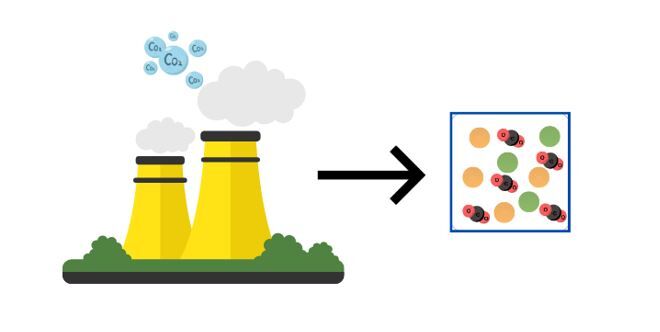
Global warming and climate change have been triggered by the excessive burning of fossil fuels and the subsequent accumulation of greenhouse gases (mainly CO2) in the atmosphere. Effective technologies for mitigating environmental issues include CO2 capture, utilization, and storage (CCUS). The CCUS is a one of the good options to reduce the global CO2 emission from industrial processes. Taiwan is moving toward 2050 net-zero goals, and industry is urged to reduce CO2 emissions. Currently, the conventional aqueous ammonia scrubbing is the most frequently used technology in CO2 capture, despite a number of limitations, such as high corrosion, consume high energy, and thermal decay of amine during regeneration still remains. Alternatively, adsorption using a specific and appropriate adsorbents could improve the process for CO2 capture, owing to its high energy efficiency and easy regeneration process. In recent years, MOFs have considered as a prominent and outstanding porous and crystalline nanomaterial in gas adsorption and separation due to their uniform pore size with high potential application for CO2 capture. Their special properties including tunable structure and excellent thermal and chemical stabilities poses them for high amount of gas storage. For example, ZIF-8 which consists of the coordination between zinc atoms and imidazolate linkers, has been recognized as the most investigated MOFs for CO2 capture due to its chemical stability and robustness. However, the selectivity of ZIF-8 to capture CO2 is still challenging, thus the modification of ZIF-8 is required. ILs, also known as green solvents, has attracted a significant considerable attention as a selective sorption material for CO2 capture, due to their unique properties such as non-flammable and low volatile materials. The experimental and molecular simulation approaches to selectively CO2 capture with hybrid MOFs will be investigated in this study. Low cost, green friendly, easy synthesized MOFs, and recyclability are the main focus on novelty of hybrid MOFs which comparable with activated carbon. The intern will learn the CO2 capture process in Taiwan industry and also research for adsorption isotherm in NTUT for reducing CO2 emission in order to achieve Taiwan target. Therefore, the current research provides an effective approach to reduce the CO2 emission and this would be beneficial in designing CO2 capture and storage processes in industrial applications.
The students who come to Taiwan will learn many instruments analysis including FTIR, thermal gravimetric analysis (TGA), scanning electron microscope (SEM), gas chromatography (GC) and isotherm CO2 adsorption separation setup. Adsorption separation can be applied to multiple mixed gases, making it suitable for real industrial conditions. The selected green solvents will be used for CO2 capture and storage. The research will be conducted on-campus research and industry-university collaboration will be tightened strong collaboration with research-real based experience. The subsidy amount for student is NTD 15,000/month with minimum stay of four months.
![]()
- Field: Engineering
- School: National Taipei University of Technology
- Organizer: Department of Chemical Engineering and Biotechnology
- Period of Apply: 2026/01/31-2026/12/30
- Term: 2026/06/31-2026/12/30
- Fee: Accomodation fee: NTD 3,000/month and living cost: NTD 12,000/month
- Website of Program: teep.studyintaiwan.org/program/1274




- Contact Person:Ardila Hayu Tiwikrama
- Email:ardilahayu@mail.ntut.edu.tw
- Phone:02-2771-2171#2586