









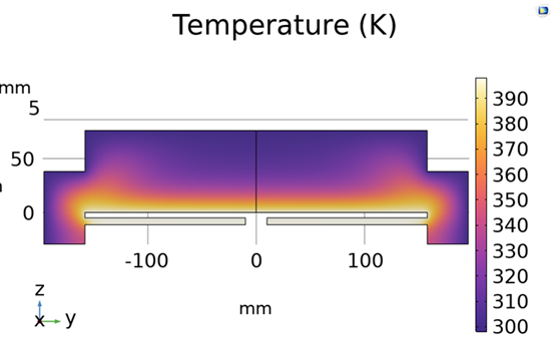
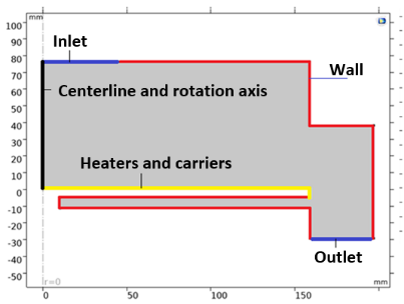
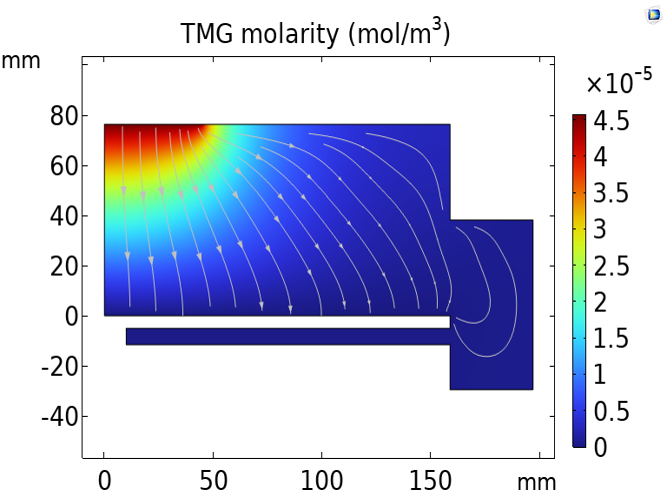
Project: Numerical Simulation of the Effects of Different Flow Fields and Temperature Fields on Thin Film Deposition Uniformity in Metal-Organic Chemical Vapor Deposition (MOCVD) Project Description This project focuses on the numerical simulation of thin film growth in Metal-Organic Chemical Vapor Deposition (MOCVD) systems, with particular emphasis on how variations in flow fields and temperature fields influence deposition uniformity. MOCVD is a critical technique in semiconductor fabrication, widely used for producing high-quality epitaxial layers in applications such as light-emitting diodes (LEDs), power devices, and advanced integrated circuits. Achieving uniform film thickness and composition across the substrate is essential for device performance, yield, and reliability. The primary objective of this study is to develop a comprehensive computational model that captures the coupled phenomena governing MOCVD processes, including fluid dynamics, heat transfer, mass transport, and surface chemical reactions. By solving the Navier–Stokes equations alongside energy and species transport equations, the model will simulate the behavior of precursor gases as they flow through the reactor, decompose, and deposit material onto the substrate surface. Special attention will be given to the interplay between reactor geometry, gas inlet configuration, and thermal gradients, all of which significantly affect local deposition rates. Different flow regimes—such as laminar, transitional, and recirculating flows—will be systematically analyzed to understand their impact on precursor distribution and boundary layer development. Similarly, temperature field variations, arising from substrate heating methods or reactor design, will be examined to determine their role in reaction kinetics and film growth rates. The study will evaluate how non-uniformities in these fields lead to spatial variations in thickness, composition, and material properties of the deposited thin films. Advanced numerical tools, such as computational fluid dynamics (CFD) software, will be employed to perform parametric studies. These simulations will allow for the optimization of process conditions, including gas flow rates, pressure, temperature profiles, and reactor configurations. The ultimate goal is to identify design and operating strategies that minimize thickness variation and enhance deposition uniformity across large-area substrates. The outcomes of this project are expected to provide valuable insights into the fundamental mechanisms of MOCVD processes and offer practical guidelines for reactor design and process optimization. This work will contribute to improving the efficiency and scalability of semiconductor manufacturing, particularly in applications requiring precise control of thin film properties. Scholarship: NT$20,000 per month for 3 months Costs: Accommodation (dormitory) fee plus living expenses Accommodation: University dormitory, shared by 4 students per room Duration: 3 months Participation Requirements: Major in Engineering; background in fluid and thermal mechanics is advantageous Language Proficiency: Ability to communicate effectively with the advisor
![]()
- Field: Engineering
- School: Tatung University
- Organizer: Department of Mechanical and Materials Engineering
- Period of Apply: 2026/04/01-2026/10/31
- Term: 2026/06/01-2026/08/31
- Fee: Living expenses (including flat fee): 15000 NT/per month

- Contact Person:Chehung Wei
- Email:cwei@gm.ttu.edu.tw
- Phone:02-21822928 ext 6169